
The Emerging Science of Happiness: How AI Is Beginning to Support Women’s Well-Being
Abstract
This article examines the growing role of artificial intelligence in supporting women’s mental health, emotional well-being, and overall quality of life. Drawing from recent studies in digital mental health, AI-assisted care, and gender-specific research, we explore how AI tools are improving access to support systems that have historically underserved women. The analysis highlights key areas where AI is creating measurable impact, including emotional support, healthcare accessibility, and personalized well-being interventions. At the same time, it critically evaluates risks such as algorithmic bias, over-reliance, and the limitations of machine-driven empathy. The findings suggest that AI is most effective when positioned not as a replacement for human care, but as a complementary system that expands access, reduces barriers, and empowers women to better understand and manage their well-being.
Introduction
For decades, women’s well-being has been shaped by a simple reality:
👉 Access to support is often inconsistent, delayed, or insufficient.
From mental health services to general healthcare, many women experience:
- dismissal of symptoms
- delayed diagnoses
- limited access to personalized care
But something new is emerging.
Not as a replacement for human care—but as anaugmentation layer:
👉 Artificial intelligence.
What the Data Shows
Recent research indicates that AI is already influencing well-being outcomes.
Studies using OECD survey data show that AI use is associated with:
- improved mental health
- increased job satisfaction
- better overall well-being
Notably:
👉Women report stronger mental health gains from AI usage than men
This suggests that AI may be addressing gaps that traditional systems have struggled to fill.
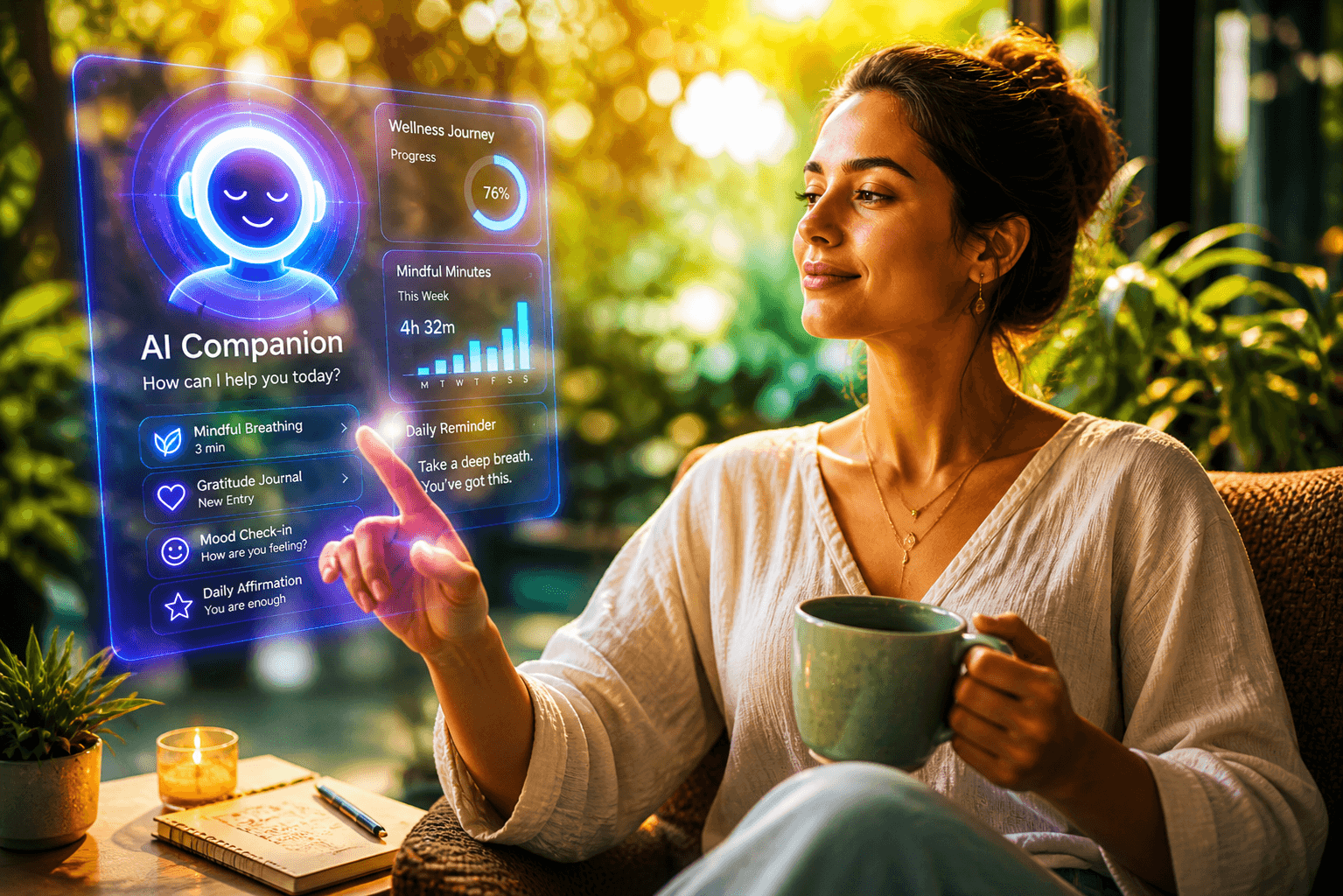
AI as an Emotional Support Layer
AI-powered tools—especially conversational agents—are increasingly used for:
- emotional reflection
- stress management
- journaling and self-awareness
Evidence shows these tools can:
- reduce anxiety and depression symptoms
- improve emotional regulation
- provide consistent, stigma-free support
For many women, this matters deeply.
Because AI offers something rare:
👉Availability without judgment
Bridging Gaps in Women’s Healthcare
One of the most significant areas of impact is healthcare access.
Many women report turning to AI tools when:
- healthcare systems fail to listen
- access is limited or expensive
In real-world cases, women use AI to:
- better understand symptoms
- prepare for medical consultations
- navigate complex health concerns
AI does not replace doctors—but itreduces the gap between uncertainty and clarity.
Culturally Aware AI and Inclusion
AI is also evolving to become more culturally responsive.
Projects like AI-driven mental health systems tailored for specific communities show that:
- culturally aligned support increases trust
- users feel more understood and engaged
For example, AI tools designed with cultural and religious context improved emotional engagement and therapeutic trust among women users
This represents a major shift:
👉 From generic care → to personalized, identity-aware support
The Limitations (And Why They Matter)
Despite its promise, AI is not without risks.
1. Lack of Emotional Depth
AI can simulate empathy—but does not truly understand human experience.
2. Risk of Bias
Some systems still underrepresent or misinterpret women’s health concerns.
Studies show AI tools can:
- downplay severity in women’s cases
- reflect biased training data
3. Over-Reliance
There is a risk that users may:
- depend too heavily on AI
- delay seeking professional help
Discussion
The key insight is not that AI is perfect.
It is that:
👉AI is expanding access where traditional systems fall short
For women especially, this matters because:
- barriers to care are structural
- emotional support is often inaccessible
- personalization has historically been limited
AI begins to change this equation.
A New Model of Well-Being
The future is not AI vs human care.
It is:
👉AI + human systems working together
Where AI provides:
- accessibility
- continuity
- early support
And humans provide:
- depth
- empathy
- judgment
Conclusion
AI will not solve happiness.
But it can remove barriers that prevent it.
For many women, that is already a meaningful shift.
Not because technology replaces humanity—
But because it helps systems finally meet it.
References
- Voraprapa Nakavachara (2025). AI and Worker Well-Being: Differential Impacts Across Generational Cohorts and Genders. OECD AI Survey Study.
- Various (2022). Artificial Intelligence in Mental Health. Clinical & Digital Mental Health Research.
- Various (2019–2023). AI Therapist (Chatbot-Based Interventions). Digital Mental Health Studies.
- Yasmin Zaraket et al. (2026). YAQIN: AI Mental Healthcare Support for Women. AI & Mental Health Research.
- Various (2026). Women Turning to AI for Health Support. Health & Technology Reporting.
- LSE Study (2025). AI Bias in Women’s Health Systems. Public Policy & AI Ethics.